


HANDLEIDING VOOR HOUTAFWERKING
Oil, varnish, lacquer or polyurethane?
Zo kies je de juiste afwerking voor je houten vloer

Door Jan Torfs, Global R&D Director bij Rubio Monocoat. Meer dan 20 jaar ervaring op het gebied van houtbeschermingschemie, moleculaire binding en naleving van regelgeving.
OP DEZE PAGINA
BASISPRINCIPES
VERGELIJK DE OPTIES
Het korte antwoord
Voor het meeste hout binnenshuis is een indringende hardwaxolie op lange termijn de betere keuze. De olie bindt in het hout, behoudt de natuurlijke uitstraling en voelbaarheid, en krassen herstel je plaatselijk zonder de hele vloer opnieuw te schuren. Kies een filmvormende afwerking zoals lak of polyurethaan alleen wanneer je een gesloten oppervlak met veel glans wilt en accepteert dat je alles volledig terugschuurt zodra die laag het uiteindelijk begeeft.
Ontdek houtbescherming van Rubio Monocoat
HET PRINCIPE
Binnendringende houtafwerking vs. filmvormende lak
De vraag die iedereen stelt is “olie of lak?”, maar daaronder zit iets veel eenvoudigers dan al die productnamen suggereren. Elke houtafwerking doet één van twee dingen. Ze trekt in het hout, of ze blijft er bovenop liggen.
Een indringende afwerking (olie en hardwaxolie)...
wordt opgenomen door de houtvezels. Het hout blijft open, je houdt de nerf en de structuur onder je
hand, en de bescherming zit ín het oppervlak in plaats van erop.
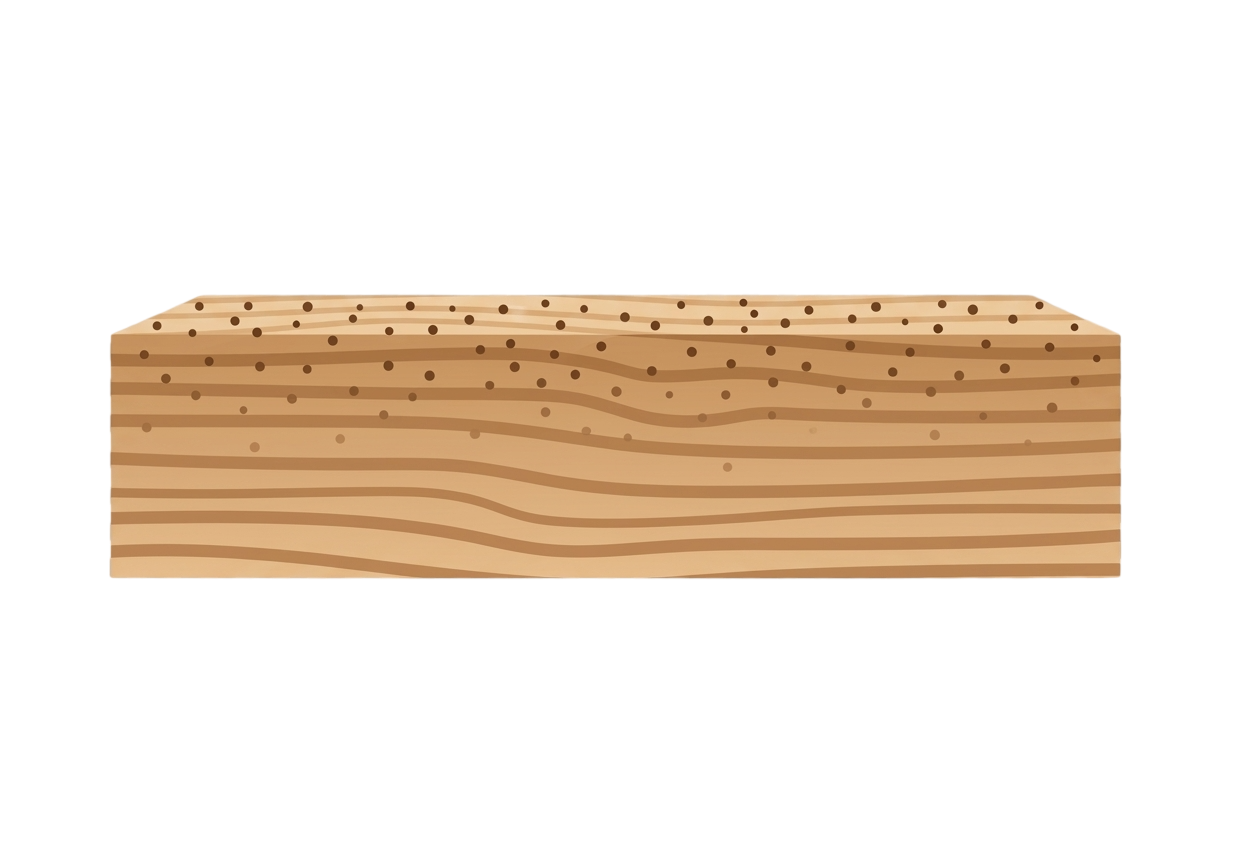
Olie dringt binnen in het hout
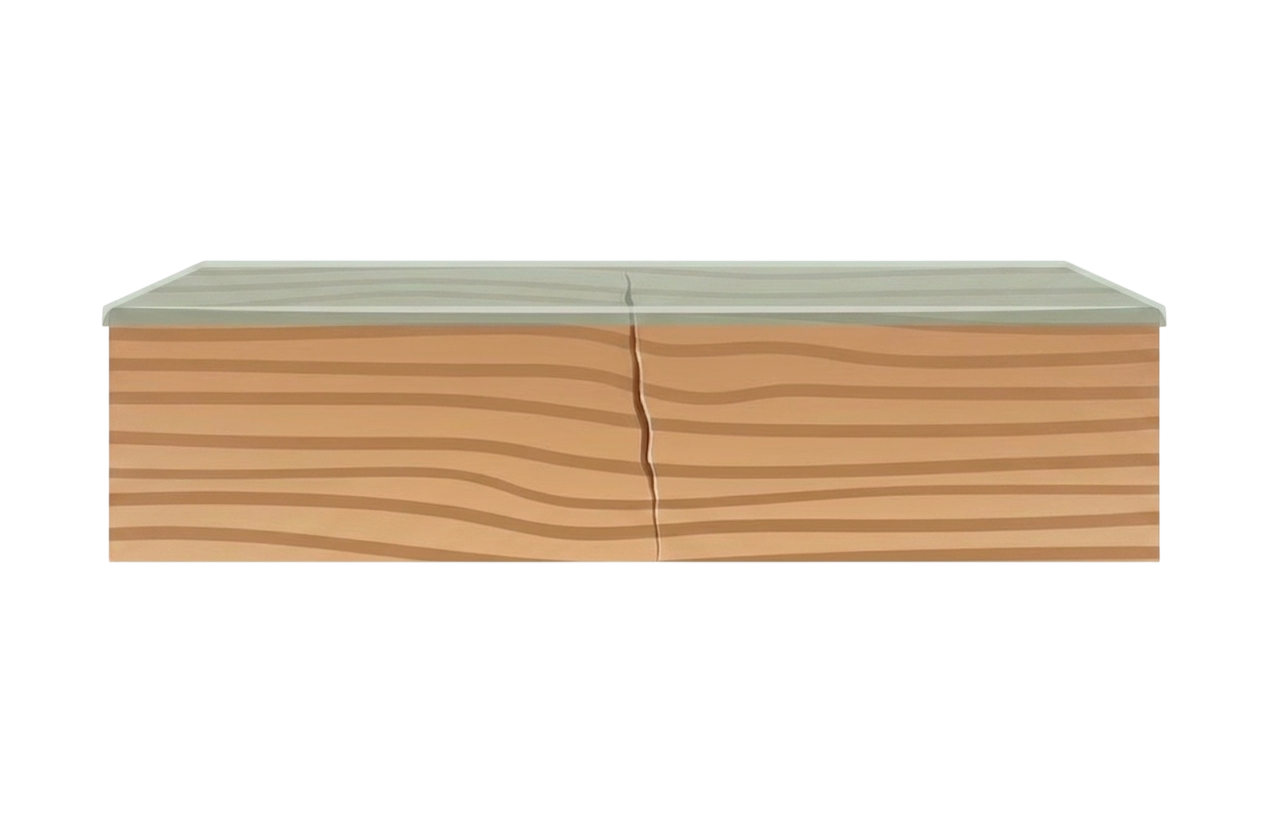
Lak vormt een filmlaag die kan barsten
Een filmvormende afwerking (lak, polyurethaan, de meeste vernissen) ...
vormt een laag op het hout. Die sluit het oppervlak af als een transparant “filmachtig” velletje. Dat velletje is hard, maar het is ook waar de problemen beginnen: bij een kras breekt de film, tekent die zich wit af, en is het hele vlak terugschuren tot op het blanke hout de enige nette oplossing.
Hoe ze werken
Vijf soorten houtafwerking en hoe ze werken
Vijf soorten afwerking, vijf verschillende manieren om hout te beschermen en vijf heel verschillende resultaten naarmate ze slijten.
DOORDRINGEND
Traditionele houtolie
Pure lijnolie of tungolie, en mengsels zoals Deense olie. Ze voeden het hout en geven de meest natuurlijke uitstraling
die er is, maar bieden weinig slijtvastheid en vragen elke 12 tot 18 maanden een nieuwe onderhoudslaag. Prima voor een werkstuk in het atelier, te veel onderhoud voor een druk belopen vloer of een keukenblad.
FILMAFWERKING
Lak
Een sneldrogende film die op het oppervlak blijft liggen en tot hoogglans opgebouwd kan worden. Lak ziet strak uit en sluit het hout goed af, maar die dunne film is bros. Een diepe kras breekt de film en tekent zich af als een witte lijn, en een reparatie loopt zelden mooi over in het verouderde oppervlak eromheen.
FILMAFWERKING
Polyurethaan
De hardste filmvormende afwerking, op waterbasis of op solventbasis. Polyurethaan vormt een harde, schuurvaste schil en is echt duurzaam zolang de film intact is. De keerzijde geldt voor alle filmlagen: zodra de film doorslijt of breekt, betekent herstel volledig schuren en opnieuw afwerken in plaats van een plaatselijke reparatie. Versies op
solventbasis hebben daarnaast een sterke geur en een hoger VOC-gehalte.
FILMAFWERKING
Vernis
Een oudere categorie, meestal een mengsel van drogende oliën en harsen. In de praktijk wordt “vernis” losjes gebruikt voor elke transparante toplaag. Echte vernis gedraagt zich als een filmvormende afwerking: beschermend zolang de laag intact is, moeilijk onzichtbaar te herstellen en met de jaren geneigd om te vergelen.
AANBEVOLEN
DOORDRINGEND
Hardwaxolie
Een mengsel van natuurlijke oliën en waxen. De olie trekt in de houtvezels en de wax zet zich vlak onder het oppervlak vast, wat water- en slijtvastheid geeft met een natuurlijke, matte uitstraling.
De technologie
Wat is hardwaxolie?
Hardwaxolie combineert de natuurlijke uitstraling, de herstelbaarheid en de dampopenheid van traditionele houtolie
met een veel betere slijtvastheid.
Een tweecomponenten-hardwaxolie zoals Rubio Monocoat Oil Plus 2C gaat daarin nog een stap verder: door de olie en de wax te mengen met een verharder wordt het afgewerkte oppervlak aanzienlijk harder dan bij een standaardolie, zonder de natuurlijke voelbaarheid of het eenvoudige plaatselijke herstel te verliezen. Dit is vandaag de professionele standaard voor hout binnenshuis.
Rubio Monocoat Oil Plus 2C gaat verder dan een standaard hardwaxolie, en dat komt door moleculaire binding. De olie bindt binnen enkele minuten op moleculair niveau met de bovenste houtvezels in plaats van een film te vormen.
De praktische winst is duidelijk: één laag in plaats van drie of vier, geen overlappingen of aanzetten, na twee dagen 80% uitgehard, en een vloer of werkblad dat je in een middag herstelt in plaats van dicht te gooien voor een volledige herschuurbeurt.
Kies de afwerking bij het werk
Welke afwerking moet je kiezen? Een keuzetabel
Kies de afwerking bij het werk, niet het werk bij de afwerking.
Filmlaag
Lak / polyurethaan /vernis
Kies dit als je wilt…
Een glanzend, volledig afgesloten oppervlak en je accepteert volledig schuren bij herstel
Liever niet als…
—
Je vindt onzichtbaar plaatselijk herstel belangrijker dan maximale oppervlaktehardheid
AANBEVOLEN
Doordringend
Hardwaxolie
bijv. Rubio Monocoat Oil Plus 2C
Kies dit als je wilt…
Een natuurlijke, matte uitstraling en voelbaarheid, met plaatselijk herstel dat je zelf doet
Een vloer, trap, werkblad of meubel dat natuurlijk veroudert en herstelbaar blijft
Liever niet als…
—
Je wilt een dikke, spiegelende hoogglanslaag
—
Je gaat nooit onderhouden en wilt puur aanbrengen en vergeten
VERGELIJKING
Hardwaxolie vs. lak vs. polyurethaan: de vergelijking
Filmvormende afwerkingen zijn echt duurzaam zolang de film intact is. De keuze gaat eigenlijk over wat er gebeurt na de eerste diepe kras, en over een periode van tien jaar wint een afwerking die je onbeperkt kunt herstellen het meestal op duurzaamheid in de praktijk en op kosten.
Factor
Hardwaxolie (Rubio Monocoat Oil Plus 2C)
Lak / polyurethaan op waterbasis
Polyurethaan op oliebasis
Type binding
Moleculair, hardt uit in de vezel
Film, ligt bovenop
Film, ligt bovenop
Aantal lagen
1 laag
3–4 lagen
2–3 lagen
Uitstraling
Natuurlijk, mat, nerf op de voorgrond
Transparant tot licht glanzend
Warm amberkleurig, matige glans
Gedrag bij krassen
Loopt met de tijd weg, geen filmbreuk
Krassen worden wit, film breekt
Krassen blijven zichtbaar, film breekt
Plaatselijk herstel
Ja, licht schuren en opnieuw oliën
Moeilijk, kleurt zelden mooi bij
Moeilijk, dezelfde beperking
Full refinish needed
No, maintained indefinitely
Every 7 to 10 years
Every 10 to 15 years
VOC content
0% (certified)
Low to moderate
High (solvent-based)
Light traffic ready
12 hours
24 hours
24 to 48 hours
Full cure
5 to 7 days
7 to 14 days
14 to 21 days
Food-contact safe
Yes (EC 1935/2004 certified)
Check manufacturer
Not typically certified
THE EVIDENCE
The evidence: numbers that matter
1
single layer
MOLECULAR BOND, NO SECOND COAT NEEDED
30–50 m²/L*
coverage
LOW CONSUMPTION, LESS PRODUCT PER PROJECT
12 hours
light traffic
FULL CURE 5–7 DAYS (80% IN 2 DAYS)
0%
VOC content
GREENGUARD GOLD, EUROFINS INDOOR AIR COMFORT GOLD, A+ LABEL
Certified
food & toy safe
EC 1935/2004 FOOD CONTACT, EN 71-3 TOY SAFETY
>1,000 cycles
in the wet scrub test
PROFESSIONAL-GRADE
WEAR RESISTANCE
40
colours
PLUS CUSTOM-MADE ON REQUEST
*Usage values are indicative and depend on wood species and preparation. Always make a sample to calculate exact usage and confirm the colour on the actual wood.

GET IT RIGHT
How to apply hard wax oil?
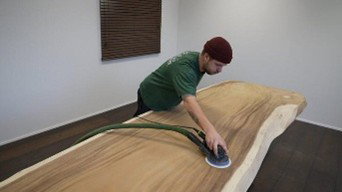
Correct application is essential for an impeccable end result. Follow these steps for Rubio Monocoat Oil Plus 2C.
1
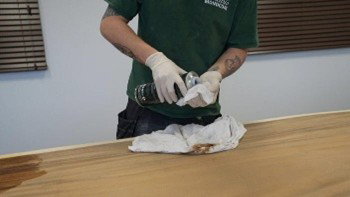
Sand the surface scratch-free. Finish at 100 grit for floors, or 100–120 grit for furniture, stairs and worktops.
2
Vacuum thoroughly, then remove the last dust with Cleaner. Any contamination weakens the bond. Let the surface dry fully.
3
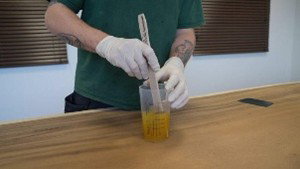
Mix the components: 3 parts A (oil) to 1 part B (hardener). Stir for 1 to 2 minutes until fully combined.
4
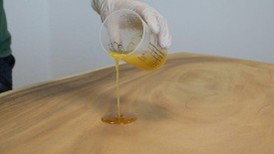
Apply a small quantity with a beige or red pad, working in zones of 5–10 m² on floors, in the direction of the grain.
5
Let it absorb for a few minutes.
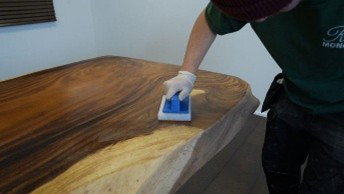
6
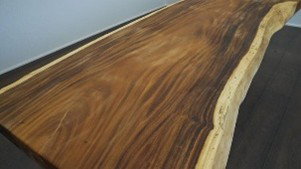
Remove all excess with a white pad or cloth. The surface should feel non-sticky. This is the step people tend to skip, and the one that matters most.
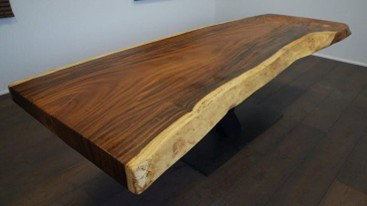
7
Allow to cure. Light foot traffic after about 12 hours, full cure in 5–7 days. Keep water and cleaning products off it for the first 5 days.
Temperature & safety note:
Work between 8 and 30 °C. Soak all cloths and pads in water before disposal, oil-soaked rags can self-heat and catch fire.
Match the finish to the ENVIRONMENT
Indoors or outdoors? Pick the right product
Wood finishings that work indoors will not survive UV, rain and freeze-thaw cycles outside. Here’s how to match your wood protection to the environment.
Questions
Frequently asked questions
For most floors, penetrating hard wax oil is the better long-term choice. It keeps the natural look and feel, and scratches blend in and can be repaired locally without sanding the whole floor.
A varnish or lacquer gives a harder, sealed surface, but any deep scratch breaks the film, and the fix is a full sand-back. Over a decade, the repairable oil finish is usually the more practical option.
In a laboratory abrasion test the scores are comparable, and in real use over ten years hard wax oil often outperforms polyurethane.
The reason is repairability. Polyurethane scratches are visible and permanent until the whole floor is sanded; hard wax oil scratches blend in and can be fixed in an afternoon. A finish you can maintain indefinitely beats one that needs full replacement every 10 to 15 years.
They are all film finishes that sit on top of the wood, with different chemistry and hardness.
Lacquer is a fast-drying film that can be built to high gloss but is relatively thin. Polyurethane is the toughest film, water-based or solvent-based. Varnish is an older oil-and-resin blend. All three protect well while intact, and all three need a full refinish rather than a local repair when they fail.
No. A penetrating oil needs to reach bare wood to bond, and it cannot soak through a film.
If the surface is currently varnished or lacquered, it must be sanded back to bare wood before applying a hard wax oil. Once it is oiled, future maintenance no longer needs that full sand.
A food-safe hard wax oil such as Oil Plus 2C is the strongest long-term choice for a wooden worktop.
It is certified for food contact, water and heat resistant once cured, and a knife mark or burn can be spot repaired invisibly. A lacquered worktop is marginally harder at first, but any damage means refinishing a large area to match the surrounding sheen.
Of all common floor finishes, hard wax oil is the best choice for homes with pets. Not because it is harder, but because claw marks can be repaired invisibly without sanding the whole floor. With Oil Plus 2C, a claw scratch compresses the fibres rather than cracking a film. Apply a small amount of oil to the area, work it in, and the mark disappears.
About the author
Jan Torfs
Global R&D Director at Rubio Monocoat
Jan Torfs is Global R&D Director at Rubio Monocoat. With over 20 years at the forefront of wood protection technology, Jan leads the science behind the company's single-layer oil system, 0% VOC standards, and third-party certification. His work covers everything from molecular bonding chemistry to food-safe and toy-safe compliance.
↑ Back to top